The Other Side of the Block
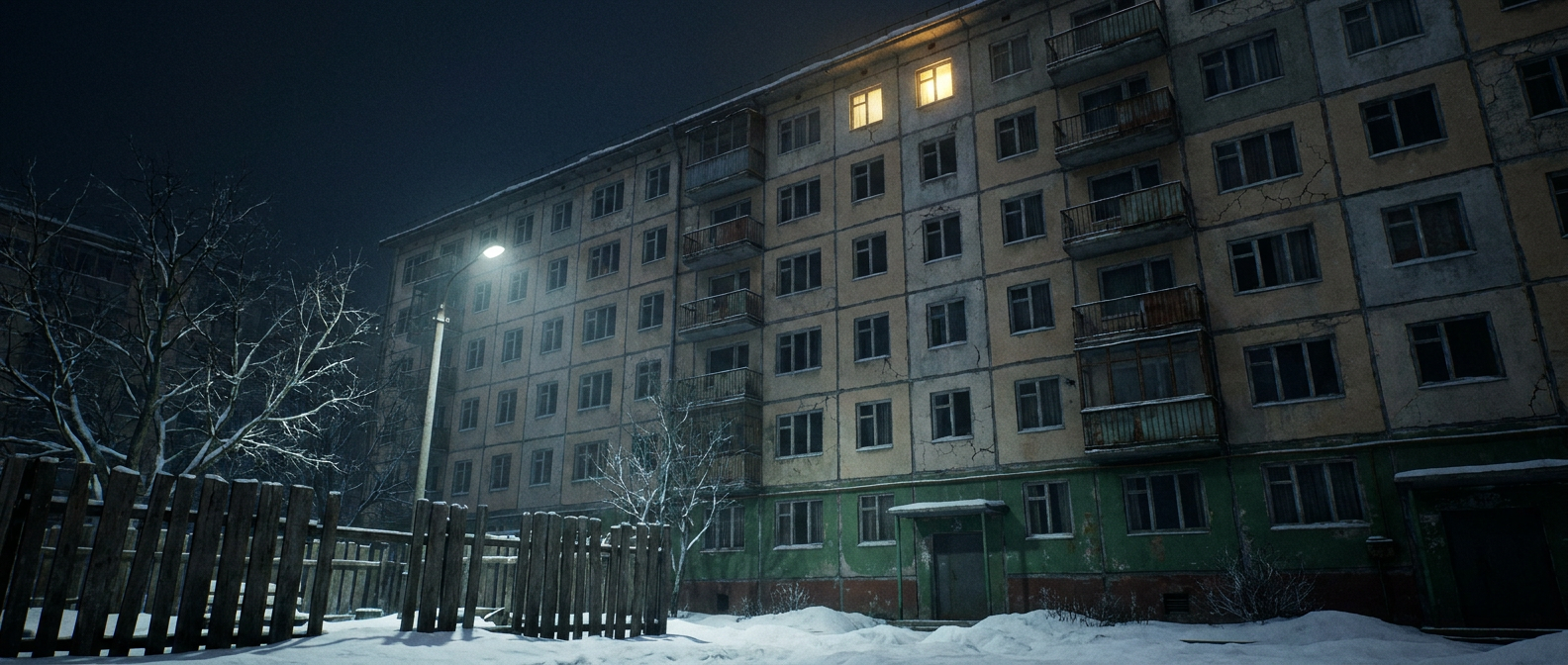
Working title «Изнанка». A first-person immersive sim: one night, one apartment block, one flat that is not on the plan.
00In 30 seconds
What you do
Find flat 91. It only exists on the other side of the block — an empty copy of the same building. Five ways lead to its door. What you find on the way decides the ending.
The cat
Feed the cat and it leads you. Walk through a door behind it and you cross to the other side. The cat is the hint system, the key between worlds, and your safe point. It is also a ghost — you learn that at the end.
Two worlds, two games
The face — real block, people, locked doors. You talk and investigate. Safe. The other side — nobody, every door open, shadows on the walls. You sneak and hide.
Three endings
You don't pick the ending in the last room. You build it: find all the traces and the cat's name — good. Reach the flat without the name — bad. Never reach it — empty.
01Design pillars & references
Four rules I design by
- One goal, many ways. Every route to flat 91 is a real route. None is "the right one".
- Hints live in the world. No markers, no arrows. A cat instead.
- Every choice has a price. The other side is faster, but shadows live there. Get caught — lose your food, lose the cat.
- Normal first, strange later. It starts as a boring job. The strange things come slowly.
What I learned from
- Dishonored 2, "A Crack in the Slab" — one place in two states, switched while you play.
- Silent Hill — the other world is a feeling, not just a new texture.
- Alan Wake — a normal man, a normal day, then one detail is wrong.
- Kingdom Come: Deliverance — neighbours are people with their own stories.
02The hook: flat 91
Max, 32, checks buildings before demolition. A normal job: a six-floor panel block on the edge of town, three stairwells, 90 flats. His file says 91. He calls the office: "a typo in the papers".
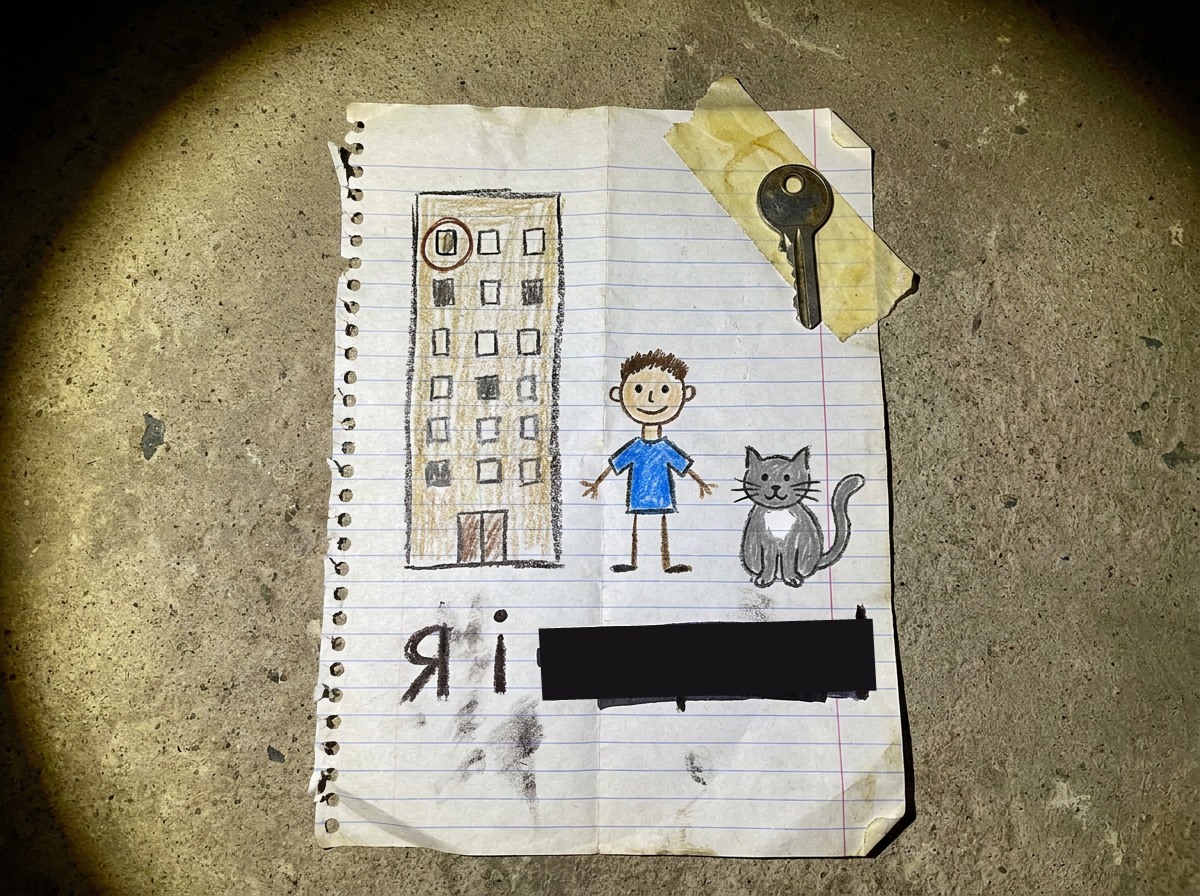
Ten minutes later he checks the mailboxes and finds box 91. Inside: a child's drawing — the block, one window under the roof circled, a small boy and a cat with a white patch. The caption says "me and ████". The cat's name is crossed out with one straight, heavy line. No child drew that line. A key is taped to the drawing.
Every resident says there is no flat 91 — and each says it in a different way. The old lady on the 2nd floor looks away. The drunk on the 3rd laughs. But traces are everywhere: the mailbox, a sanded spot on the intercom where button 91 used to be, an old plate on the attic door.
Flat 91 only exists on the other side — a door with no number at the end of a corridor that is too long. The door is there from the start, and any of the five routes gets you to it. That is the middle of the game, not the end. The key from the drawing opens the door — and behind it there is only bare concrete. The block has not given the flat back yet. The flat appears only when Max has remembered enough. Routes lead to the door; traces lead into the flat.
03Two worlds
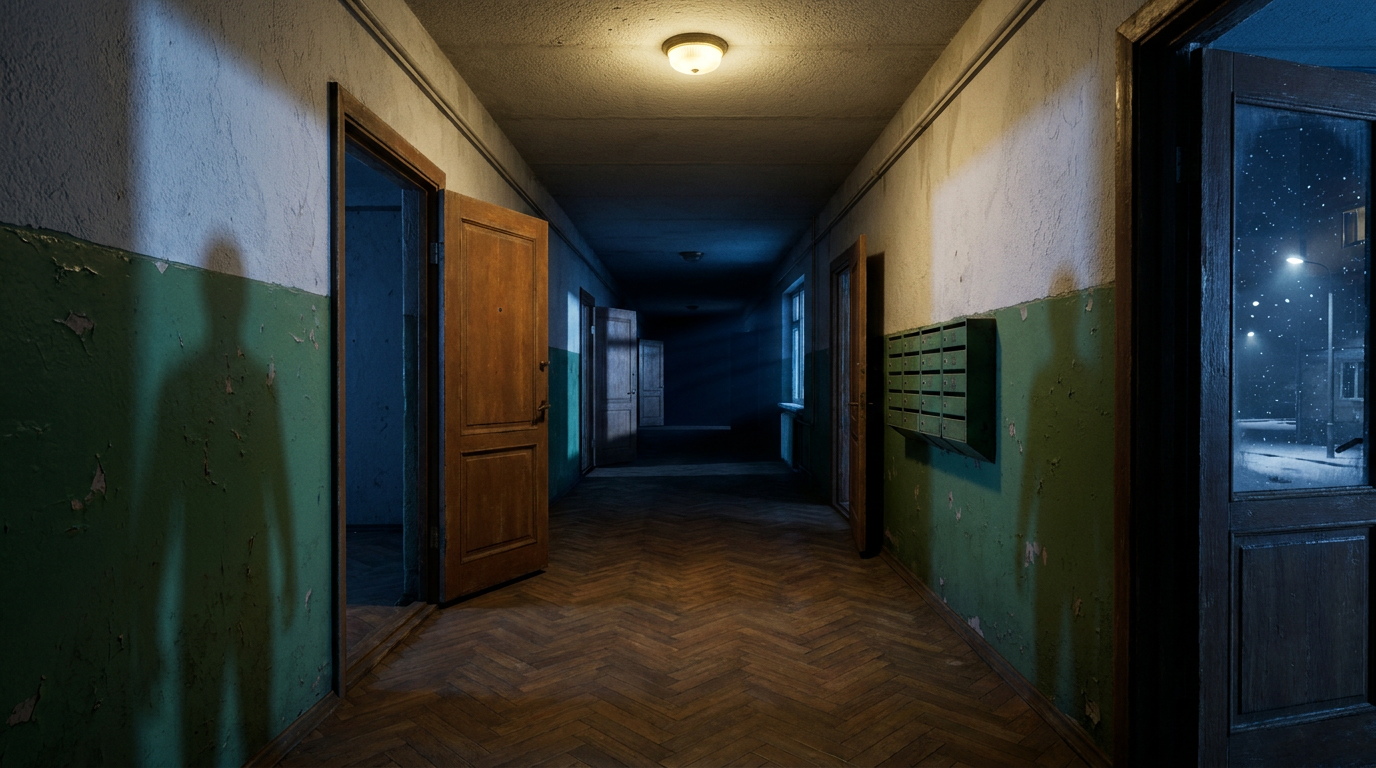
Two ways in. Behind the cat — quiet: feed it, it walks to the nearest doorway, you follow. The shadows don't know you came. Through a thin place — loud: the flickering spots that give flashbacks also let you through without the cat, but the shadows know at once. The way out is always the cat: it sits at the exit.
| The face (the block as it is) | The other side (the block as it remembers itself) | |
|---|---|---|
| What you do | Investigate & talk. Listen at doors, trade, find traces, get keys | Sneak & hide. Walk through any flat, avoid the shadows |
| People | Baba Zina, Tolik, the last tenant | Nobody. Shadows on the walls — every family the block took in 50 years |
| Flat doors | Locked, people behind them | Open |
| Danger | None — a safe zone. Doors stay shut, people stay silent | The shadows catch you — you're thrown back to the face and all your food is gone |
| Space | As built | As remembered: stairs collapsed, corridors too long, passages the face never had |
| Flat 91 | Doesn't exist | Exists |
| Time | Moves with the story, no timer | Stands still |
04The cat as a system
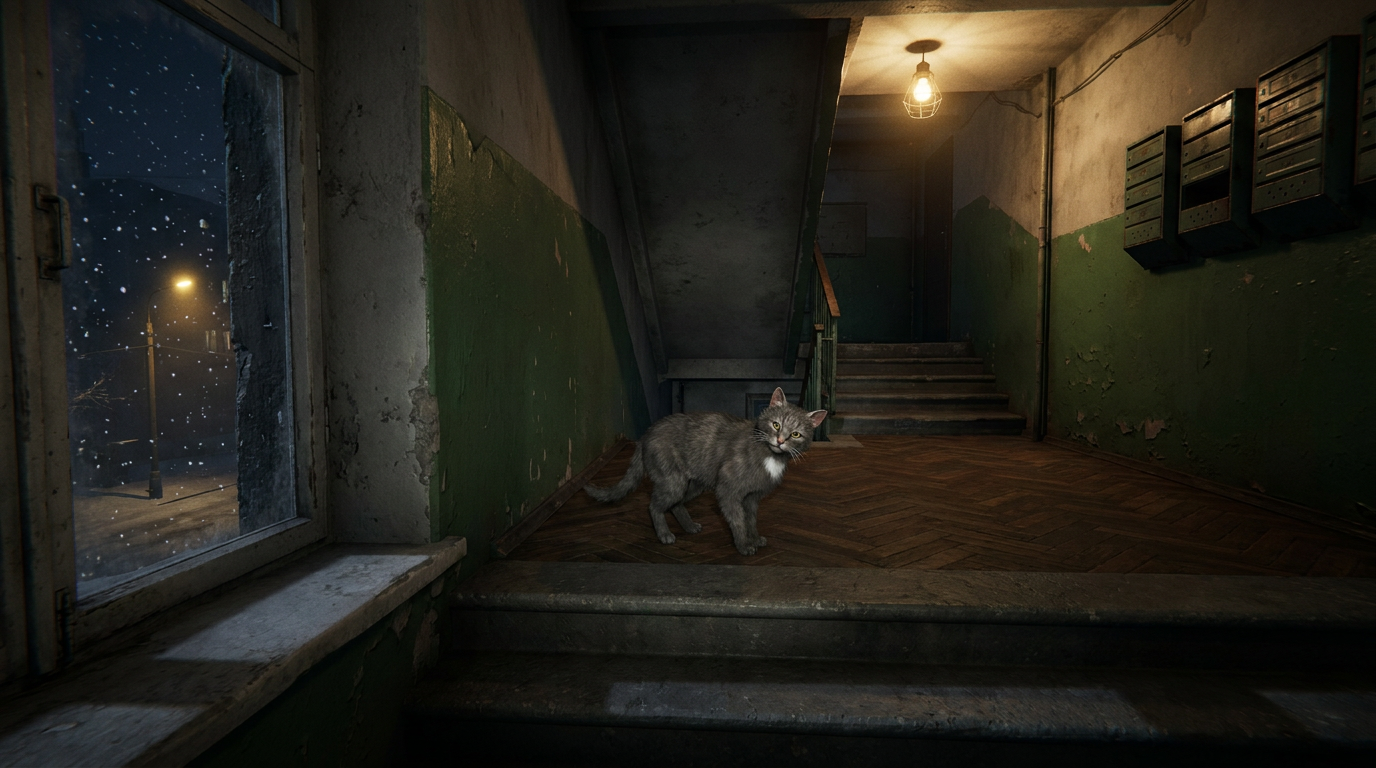
- Leading. Taught once, in the tutorial: feed the cat and it leads. A fed cat walks around you, goes ahead and looks back at you. That look is the whole hint. No marker, no text.
- Calling. Take food into your hands and the cat comes. Food in the block is limited, so you can't call it forever.
- Hurting it (hit, scare, starve) makes it leave for a while. You can still enter the other side through a thin place — loudly.
- On the other side the cat sits at the exit. You can always come back to it and leave. It is your safe point.
- Distraction. A fed cat can pull a shadow away. A hungry one won't.
- Flashbacks. The cat can lead you to a flickering spot — see Memory below.
- A ghost. You learn this only at the end: it is Max's own cat. The block took its name. It has its own goal.
05Core mechanics
What the player can do
Walk, sneak, crouch, take / put, open / close, talk, listen at a door, feed the cat, pet the cat, flashlight on / off. No fighting. If the shadows catch you, you're thrown back to the face and lose all your food — but not your traces. Losing a trace makes you angry at the game. Losing food means losing the cat, and you feel that price at once.
Shadows (other side)
They notice you by light (your flashlight) and by sound (steps on concrete; on carpet you're quiet). You can't fight them. You go around, or hide under a bed or in a wardrobe and wait. A fed cat can pull one away.
Feeling them coming
No alert bar. A whisper gets louder as they get closer, and the screen starts to shake a little. The player reads danger with ears and nerves, not with UI.
Time
No timer. The player should not hurry — the block is there to explore. The night moves on with the story: after key events the hour changes, and morning comes with the ending.
The face: investigation
The face is safe: no enemies, the stairs are lit, Max is here for work. The only obstacles are locked doors and people who won't open without trust. You listen at doors, talk, and bring residents things you found on the other side: their photos, their lost objects. Trust grows with the right object and dies if you lie or annoy them.
Memory & traces
Some objects and places flicker. Touch them and you get a flashback: three seconds, a voice, a few frames in a different style (black and white, grain). Reference: Alan Wake. The cat can lead you to these spots.
People on the face
| Who | Wants | Gives | How you lose them |
|---|---|---|---|
| Baba Zina, 2nd floor | Her things from the other side; "her" cat fed | The family's story, the attic key | Lie to her or annoy her — she shuts the door |
| Tolik, 3rd floor, ex-electrician | A drink; to remember who he was | Knows the basement and the garbage chute; has the chute-room key | Treat him like a drunk |
| The last tenant, 6th floor | Not to leave — he has nowhere to go | The key to the iron gate that closes off the end of the corridor. He found the boy on the stairs in 1994 and is the only one who remembers the family | Won't open to strangers. Listen at his door, bring him what he lost on the other side, and once you know the story he recognises Max and gives the key |
Traces decide the ending. Twelve traces of flat 91 are hidden in the block — the mailbox, the sanded intercom button, scratches, photos, a child's shoe. Hidden among them, in pieces, is the cat's name. You don't choose the ending in the last room; you build it by how you played.
06The block as a level
Six floors, three stairwells, 90 flats; we play in one stairwell. No lift. The block in cross-section, with the five routes:
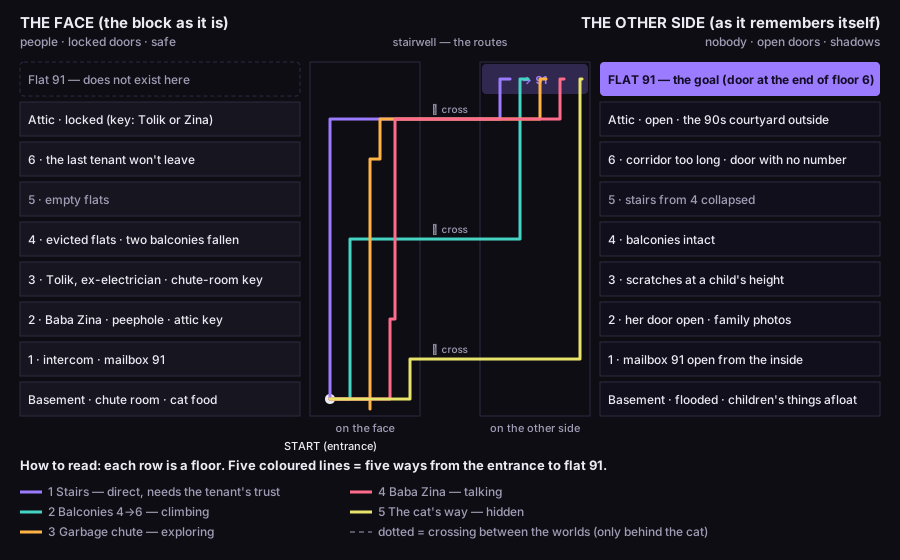
Floor by floor:
| Floor | The face | The other side |
|---|---|---|
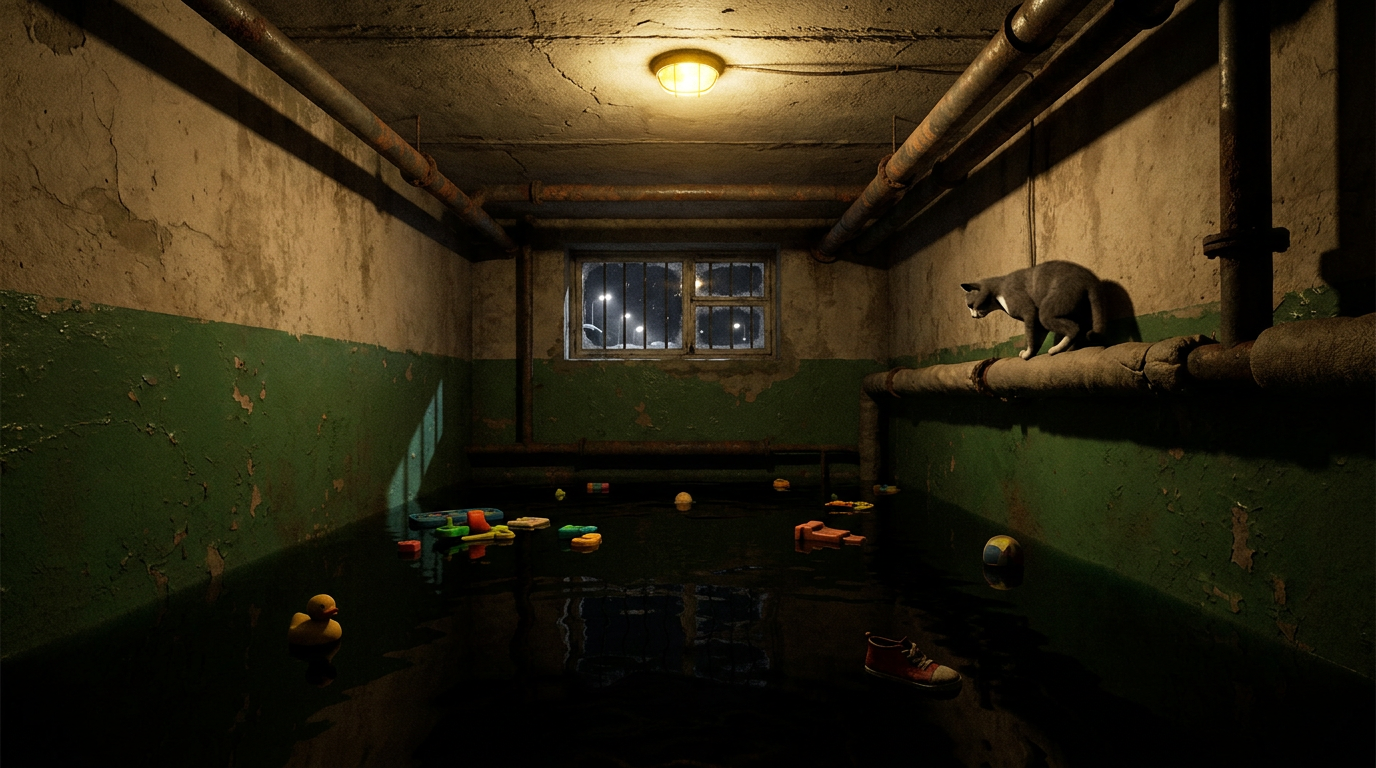
| Basement | Chute room, cat food | Flooded; children's things float on the water |
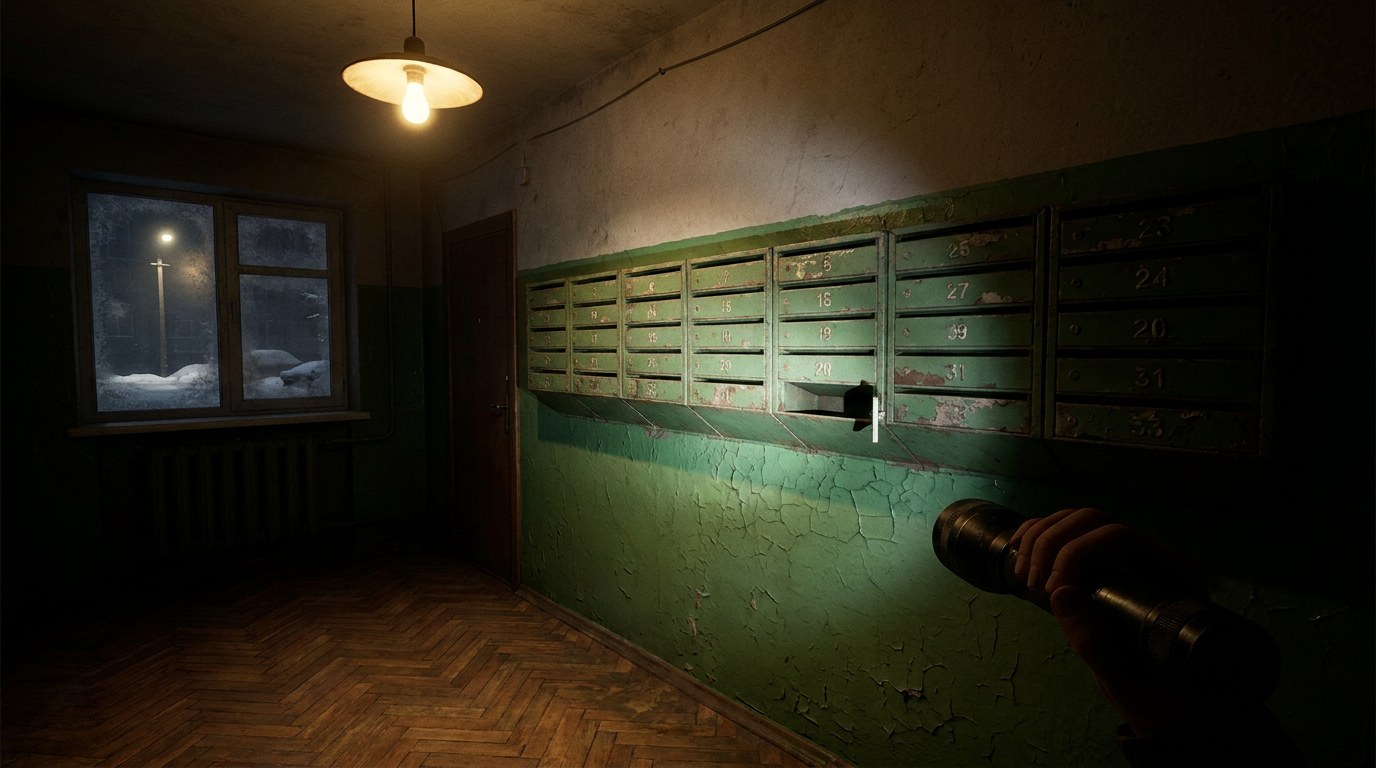
| 1 | Intercom, mailboxes | Empty; mailbox 91 is open from the inside |
| 2 | Baba Zina — watches everything through the peephole | Her door is open; family photos on the table |
| 3 | Tolik, drinks, former electrician | Scratches on his door at a child's height |
| 4 | Evicted, empty flats, balconies | Stairs to the 5th have collapsed; balconies intact |
| 5 | Empty | The corridor is longer than it should be |
| 6 | An iron gate across the end of the corridor; behind it the last tenant, who refuses to leave | A door with no number at the end of the corridor — bare concrete behind it until you remember |
| Attic / roof | Locked; Tolik or Zina has the key | Open; from the roof you see the courtyard as it was in the 90s |
| 91 | — | Here |
07Five routes to flat 91
| Route | Type | What you need | Risk |
|---|---|---|---|
| Stairs (face) | Direct | The gate key from the last tenant — through trust, or something you overheard | Without it the end of the 6th-floor corridor stays shut |
| Balconies, 4th → 6th | Climbing | On the other side the balconies are intact; on the face two have fallen | Shadows on the balconies; no way back without the cat |
| Garbage chute | Exploring | Key to the chute room in the basement (Tolik), flashlight | Climbing inside the chute on the other side, in the dark; shadows hear every scrape |
| Baba Zina | Talking | Her things from the other side + feed "her" cat — which is our cat | The attic key and the story — or a shut door if you lie |
| The cat's way | Hidden | The cat's trust | Through the attic on the other side straight into 91 |
Every route can be walked on the face or on the other side. Each has its own price in each world.
08Story & endings
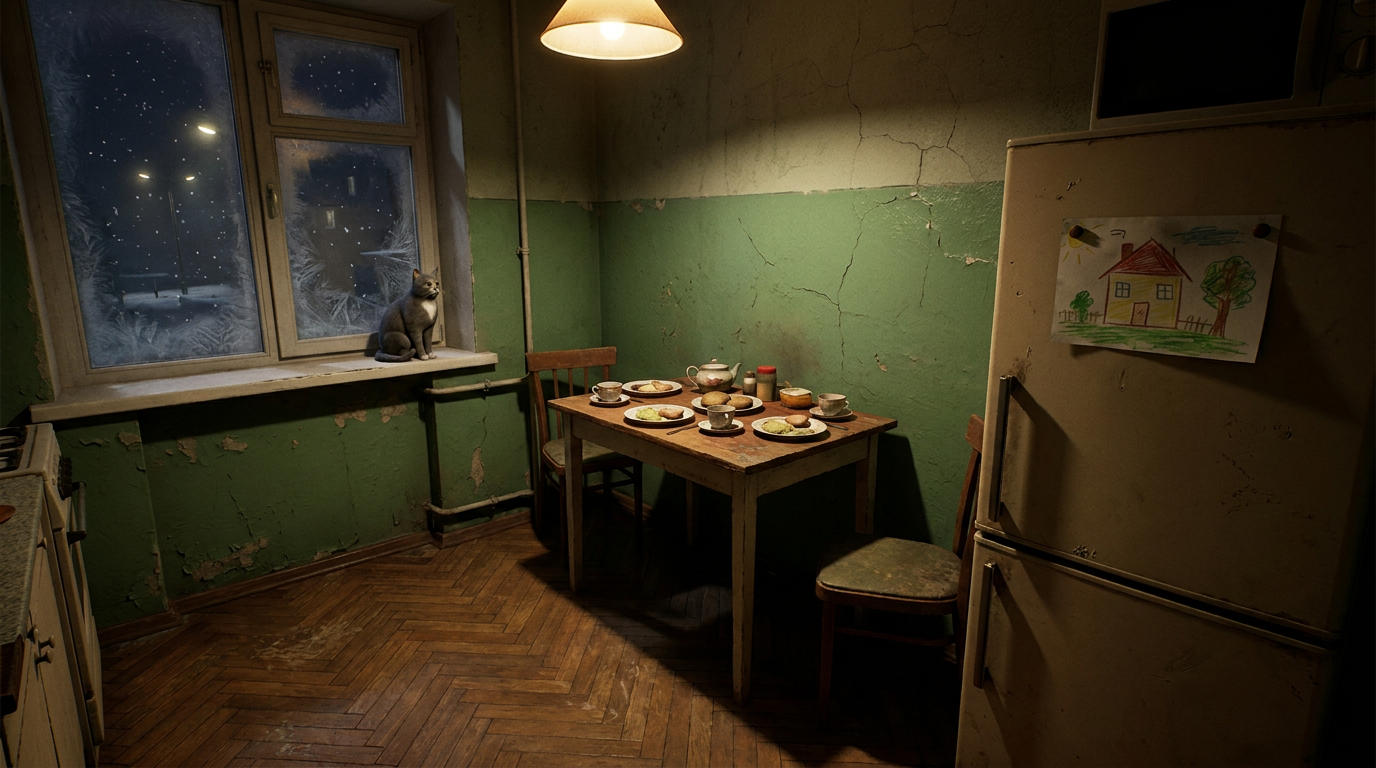
Winter 1994, Ukraine. A six-floor panel block on the edge of a big city. Flat 91 under the roof: mother, father, a seven-year-old boy, and a grey cat with a white patch called Tysha — Ukrainian for "silence". The boy named it that because it never meowed. The boy is dying. There is no money for treatment, and there won't be. One night the father says to the kitchen wall: "take anything, just let him live". In the morning the boy is healthy. The block heard him. For the block this is a deal: the flat and everyone in it, in one week.
The father understands when the door stops opening for him: the block holds the one who made the deal. On the night of payment he opens the door and stands in the doorway. The cat walks out first; the boy follows the cat. "Sit here, wait" — said from the doorway. The mother could leave — she didn't make the deal. She stays. Her choice, and the scene Max will remember in flat 91. The father puts the drawing and the key into mailbox 91.
The block's rule: it takes what belongs to the flat. The parents are inside — it takes them whole. The boy and the cat are outside, and through the doorway the block can only reach what was born in that flat: from the boy, his childhood — his memory; from the cat, the name it got in that kitchen. Their bodies stay on the stairs; the deal doesn't reach past the door. It is not a punishment. It is a debt being paid. The cat's name on the drawing erases itself, in one straight inhuman line. A cat with no name is not a cat and not a ghost — it sits in the doorway between the worlds for thirty years and waits.
Today the city is demolishing the block. The shadows on the other side are every family the block took in fifty years. The cat wants one simple thing, and it is not a human wish: bring the boy home. For the cat, home is the other side.
The ending is built, not chosen. The key is the cat's name, and it hides in plain sight: tysha means "silence", so the player reads it in notes around the block — "Tysha, hush", "it's quiet here now" — as a normal word. Only with enough traces does it click: it was a name. The last line on the drawing: "me and Tysha".
Give the name back good · all traces
Enter 91, remember that night, write the cat's name back on the drawing. The name was taken through the doorway — outside the deal. Giving it back breaks the deal. The parents are free: gone, but no longer locked in. The cat is whole again and goes where they went — down the stairs, out into the morning yard, and it doesn't look back. The flat dissolves. The block can be demolished.
Stay bad · reached 91, no name
You remember the family and couldn't save anyone. You walk in and stay — with your parents and the cat, in a flat that doesn't exist, forever. The block got everyone. Credits roll on the other side.
Sign empty · never reached 91
In the morning you sign the demolition papers and drive away with no memory. Alive, but empty. The cat stays by mailbox 91, under the rubble.
09What this document shows
Systems with clear rules and prices: two worlds with different jobs, a cat that is guide, key and safe point, shadows you read by ear instead of a UI bar, endings built from how you play. One level built for five routes. A setting I grew up in. The scope is one mission on purpose — this is the kind of document I would bring to a design test.